- Episode no.
- 01 of 20
- Date of record
- August 26, 2026
- Contents
- Chapter 1
- Reading time
- 12 minutes
STATUS: DECLASSIFIED
Part One · How to Get Where You Don’t Want to Go
Episode OneThe Man with the Antler-Handled Umbrella
Chapter One
The Man with the Antler-Handled Umbrella
“Time to say the pledge,” Ms. Prufrock announced, banging her ruler on a tin cup for attention. The children stood and turned to the portrait of the late Josef Mollycoddle, the Greatest Leader of All Times, who was known as the G.O.A.T. The G.O.A.T.’s portrait hung in a heavy wooden frame beside the chalkboard. On the opposite side of the chalkboard hung the portrait of his son, Hubris Mollycoddle, the Objectively Wonderful Leader, known as the O.W.L. The children raised their hands to their foreheads in salute to the G.O.A.T. and the O.W.L.
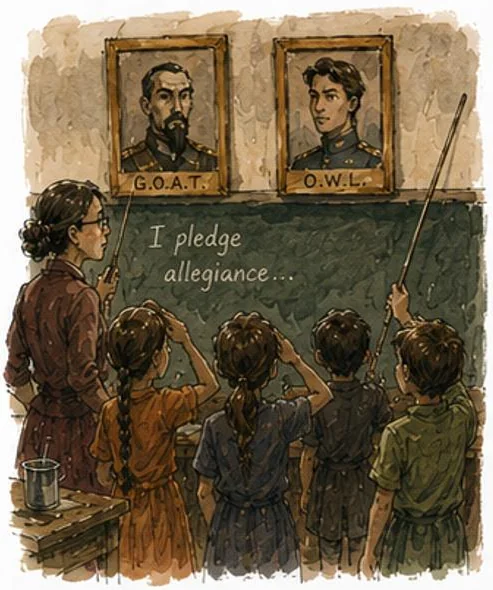
“I pledge allegiance to Josef Mollycoddle,” Katherine said, her voice blending in with the others. “The Greatest Leader of All…”
The Greatest Leader, with his gray visage and bushy brow and pointed black beard, stared back at them from the wooden frame. The children had been taught that the G.O.A.T. was the most handsome man the island had ever known. Katherine had always thought he looked like a fingerling potato that had been left too long in the sun.
“Through him, our island was saved from the invaders, and from the great famines and the snaardvark infestation…”
The children shifted their gazes to the portrait of the O.W.L. and continued on in their monotonous tone: “And I pledge allegiance to Hubris Mollycoddle, the Objectively Wonderful Leader, whose blood sprang from the Greatest Leader. Ruler from ruler, leader from leader…”
Rain started falling on the tin roof of the schoolhouse. Katherine looked around the room without turning her head. Not another child looked away from the portraits of the Leaders as they went on with the pledge. Her mind wandered. That bit about the snaardvarks she had always found suspect. The island had once been infested with rats, they had been taught. And the rats had attracted the snaardvarks to the island. And the snaardvarks were far worse than the rats. But she had never actually seen a snaardvark. She had no idea what they even looked like. She had seen plenty of rats, but never, not once, a snaardvark. She only knew that the G.O.A.T. had driven the snaardvarks back into the sea. And she knew that she should be thankful now that the island was merely infested with rats, which was much better than being infested with those horrible snaardvarks. But still, she had doubts. Lingering, pestering, festering doubts. Not that she ever expressed these doubts to anyone else.
“Forever Farflung,” ended the Pledge.
“Open your books to chapter seventy-seven,” Ms. Prufrock said.
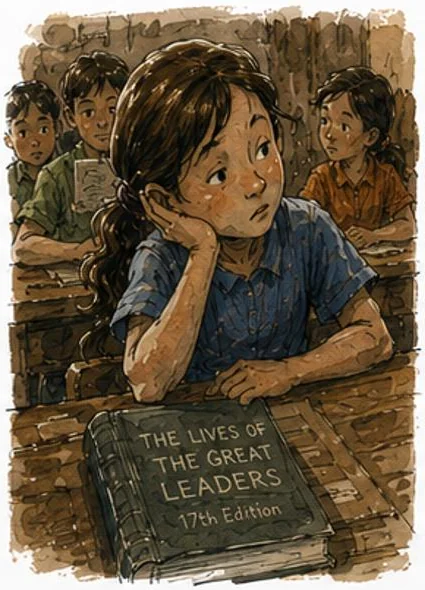
There was only one book allowed on the island of Farflung. The Lives of the Great Leaders, 17th Edition. By now, the children had memorized the first seventy-six chapters, in which they learned many interesting facts, mostly about the G.O.A.T.’s childhood, such as these:
The G.O.A.T. excelled in both games of skill and games of chance. At the age of six, he became world chess champion, defeating the long-reining Yuri Soso, who visited Farflung on a diplomatic mission and suffered his defeat at the Great Leader’s young hands in just seven moves. The G.O.A.T. lost not a single piece in the effort. And he also never once lost a game of tic-tac-toe. Or a thumb wrestling match. Or at the ancient game of Ro-sham-bo, which is also called rock-paper-scissors. Not once. The greatest challengers came from France where they called the game Shifumi and from Japan where they called it sansukumi-ken and fought not with rocks and scissors and paper, but frogs (thumb) and slugs (pinky) and snakes (index finger). It didn’t matter. He sent them all home to Paris and Tokyo in defeat.
At the age of seven, he swam across the Strait and back in only one breath. Swimming from one island to the next was not recommended for ordinary mortals. The crooked straits that separated the islands were filled with sharks and the currents were strong. Of those who had tried it, none had lived to tell the tale. If the sharks didn’t get them, then they were carried off on the never-ending waves far out into the never-ending sea, never to be heard from again. All of them, that is, except for the G.O.A.T.
At eight, he hunted gray whales in a sea skiff and dragged them with one hand to the northern shore where he butchered them himself with a pocketknife for their meat and rendered their blubber for lamp oil. The whales’ bones lie there still, like sun-bleached ship timbers wrecked on that lonely stretch of beach beyond the mountains, a graveyard for sea giants, a testament to his strength and courage.
At nine, he took up the flute and then the horn and then the bassoon. He made his way through the wind instruments and mastered them all, then moved on to the string instruments. The harp, the violin, the twelve-string guitar. He learned the entirety of brass in a day. By the end of his ninth year, he wrote a symphony that was said to so enrapture whatever audience he played before that they sat stone-faced, hypnotized by its haunting beauty and overcome with the deepest truths of their lesser souls. This condition was nearly life-threatening in its power–to the audience, and also to the musicians who played it–and so by the age of ten the G.O.A.T. had taken to playing music only for himself in a concert hall for one, specifically designed to keep in the sound.
Katherine thought of herself at six, picking through the garbage heaps, mudlarking with the orphan kids, and wondered how one might win a world chess championship at that age. It could happen, she supposed. Perhaps it was luck. Perhaps Yuri Soso had an off day. She tried, but in her heart, she didn’t believe the lessons. Or the teachers. She kept this to herself, of course. It made her uncomfortable to think this way, but she couldn’t help it. Still, she knew better than to mention it to anyone. No one else seemed to wonder about these things. If they did, they certainly didn’t speak of it. No one really wanted to talk about anything. Most people just kept their heads down and kept to themselves. Even the kids on their way to school and on their way home who might pass each other on the street and who might be tempted to be friendly, just didn’t. No one ever told them to keep to themselves. No one needed to.
Katherine opened her textbook. The pages were dog-eared, the text was heavily marked with notes in the margins, and there were lines traced below half the sentences on every page. It must have belonged to twenty-some-odd students before her.
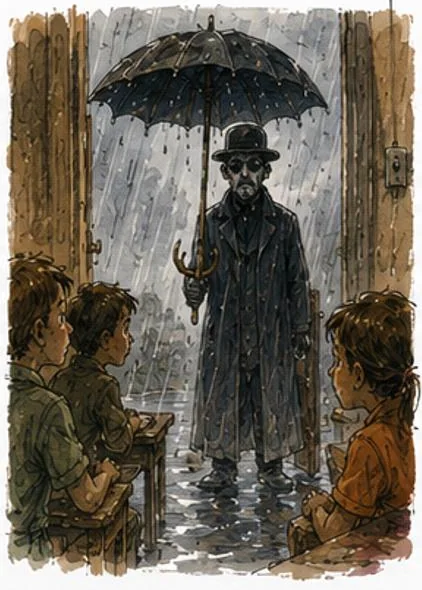
Ms. Prufrock stopped speaking mid-sentence. Katherine looked up, as did the other students. A man in a black frock coat stood in the doorway. She watched in silence as he made his way past the teacher’s desk and up the center aisle toward a seat at a too-small desk in the back of the class, looking down at each of the children with a sea-green stare and leaning on an antler-handled umbrella that he used as a cane.
The sound of thick raindrops on the roof seemed to get louder with the absence of Ms. Prufrock’s lecture. She forced a smile as the man settled awkwardly into his seat and laid his umbrella across the too-small desktop. Katherine stared straight ahead and frowned. No one ever came to the school except the students and Ms. Prufrock. Katherine rested her hands on top of her textbook.
When Ms. Prufrock was nervous, she talked too loudly, and she smiled too much. She was smiling too much now. The rest of the children sat quietly at their desks, watching Ms. Prufrock’s smile spread further and further across her face, pushing up her cheeks until nearly all of her teeth could be seen.
“OK, children!” Ms. Prufrock said too loudly to the class. “This afternoon we’re going to take a test.” She glanced at the man and then quickly looked away. He was tall, much too tall for the chair he was sitting in. His coat was still wet from the rain and dripped onto the floor.
"A surprise test." She nodded toward the figure in the back of the room. "And, we have an observer today.” She did not introduce him by name.
The man said nothing. The children turned to look at the Observer. His eyes narrowed as he met their gazes and looked them over, one by one, as if he was looking for someone, or something, in particular.
Ms. Prufrock walked up and down the aisles, handing out the test paper, the top of which read:
O.W.L.E.Y.E.
The Objectively Wonderful Leader’s End of Year Examination.
"The questions on this test are nothing we have studied before, so don't worry if you don't know some answers, just skip over them."
The kind of questions on the test were the kind that the children had never been taught. Math questions and science questions. Questions about geography and geology and the history of places Katherine had never been or even heard of.
“Ahem..." the observer made this noise, but he wasn't really coughing. It was a fake cough, and it made Ms. Prufrock even more nervous.
“Actually,” Ms. Prufrock said, “Go ahead and answer each question as best as you can.”
Katherine looked over the questions. The O.W.L.E.Y.E. began with simple arithmetic. Some of the questions were equations to be answered in a box: What is six times eight? What is the square root of four? Others were word problems to be worked out: If you walked seven miles a day from Malarkey to Newfangle, how many miles would you walk in a week? Seven times seven is forty-nine, Katherine thought, but then she wondered if you also had to walk back from Newfangle to Malarkey every night, to start the trip over every day. And if you did, should those miles count or not? If they did, then the answer was twice forty-nine, which was ninety-eight. The question wasn’t very specific. Not nearly specific enough. Katherine wondered who’d written it. Had they ever walked to Malarkey? Questions that weren’t specific enough weren’t very helpful when taking a test. It really should be re-written, she decided. She hated it when questions just assumed things that couldn’t be assumed.
The next was no better. Would you rather have three-eighths or six-fifteenths of a rhubarb pie? Katherine decided the answer depended on whether you liked rhubarb pie or not, which she didn’t, particularly, though these days you couldn’t be choosy. If you did, you’d probably want a little bit more, in which case you would likely choose three eights. If not, you’d probably want a little bit less, in which case you would choose six fifteenths. She supposed she would eat more of anything, and maybe that was the point.
And this: A basket of charcoal and a bundle of sticks cost one dollar and ten cents together. The charcoal costs a dollar more than the sticks. How much do the sticks cost? Five cents was the answer, and Katherine knew it, but she couldn’t believe anyone would pay that much for charcoal and sticks. If anyone would, she’d like to meet them. She’d sell them all the charcoal they could take.
From there, the questions became progressively more difficult. They were questions of geometry and algebra and trigonometry. And these were followed by more reasoning problems and logic puzzles. The final question was a syllogism: “All good citizens obey the Leader. All subversives are traitors. So, (a) Good citizens have nothing to fear, except the traitorous subversives, (b) Subversives should be rooted out, apprehended, and sent to Heable Deeps, (c) The Leader is Objectively Wonderful. Mark all that apply.” Katherine didn’t follow the logic of this at all. She didn’t see how any of the conclusions followed from the propositions. Another terrible question, she thought, which ought to be re-written.
Even if these questions made sense, what did it matter? She was in no mood to concentrate. There was a part of her that wanted to mark each answer she knew to be correct, and to correct the questions she knew to be flawed. But she didn’t. She couldn’t seem to pick up her pencil.
As she stared down at the test, the man in the back of the room suddenly stood up from his too-small seat and hobbled up the aisle on his cane and out of the room. Ms. Prufrock watched him go. He was standing in the hallway talking to someone out of view. He glanced back at Ms. Prufrock through the doorway. Quietly, in barely more than a whisper and without moving her lips, she said, “Don't pass this test.”
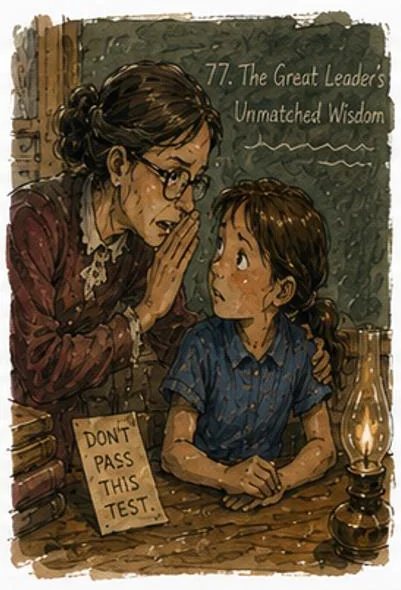
“I'm sorry, what did you say?” Katherine whispered.
Ms. Prufrock shook her head and smiled even wider, which didn't seem possible. Katherine thought her face must be in terrible pain. Ms. Prufrock shook her head quickly, still not looking at the children but only at the man in the hall.
Like a ventriloquist, without moving her lips, Ms. Prufrock said again, "Don’t…pass…this…test…" Ms. Prufrock’s eyes widened, but still she looked only at the Observer who was still standing in the hallway. “Don't pass this test!” The children exchanged confused glances.
Katherine looked down at the test, and began marking the wrong answers.
Just then the man hobbled back into the room, followed by two Hobnails. Without uttering a word, he pointed the brass tip of his umbrella at Ms. Prufrock. The guard walked to the teacher’s desk and opened the top drawer. From it, he pulled a newspaper. A thin little newspaper. Katherine could only make out the masthead. The Weekly Oxenfree. Ms. Prufrock dropped her head into her hands and began to sob, her shoulders heaving and her head bobbing up and down. “Come with us," said the Hobnail as he stepped forward and took Ms. Prufrock by the elbow.
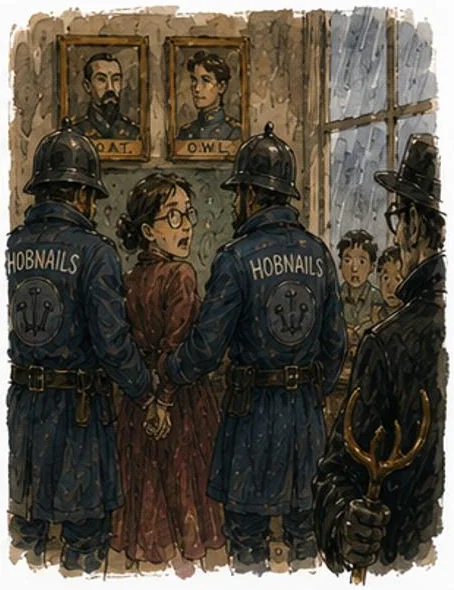
Ms. Prufrock looked back at the class as the guards led her out and began to mouth, “Don’t pass the-” but before she could finish, her mouth was covered by their hands and they pushed her out the door.
The Observer watched them go. And then he sat down in Ms. Prufrock’s chair and laid his umbrella on the desk, looking out at the class with his distant sea-green eyes. “Finish your tests,” he said as the rain pattered loudly at the window. His face seemed to stretch as if he were attempting to smile, but no smile came across it. He leaned forward. “And answer every question as best you can,” he said.